
Federal investment in babies and toddlers accounts for just 1.59% of the entire U.S. budget. Despite this underinvestment, federal programs offer essential support to the babies and toddlers who receive them. With many of these programs under threat, First Focus on Children has broken down which states stand to lose the most.
This fact sheet aggregates federal spending at the state level across 13 different programs1 that collectively make up more than 75% of all spending on children 0 – 3, including Medicaid, the Supplemental Nutrition Assistance Program (SNAP), the Earned Income Tax Credit (EITC), the Child Tax Credit (CTC), and others. For each of these programs, state-by-state spending data is collected from a variety of sources and the percentage of total spending devoted to children under 3 in that state is estimated. These numbers are combined to estimate the share of federal spending on children under 3 for each program in each state. This method captures state-level variation in federal policy, need, and demographics, as well as other issues.
This analysis finds that federal spending per child varies widely from state to state and is influenced by a range of factors including region, demographics, and the rate of child and baby poverty in each state. Alaska, New Mexico, Louisiana, Oklahoma, and Kentucky receive the most federal investment per year per child under 3. Utah, North Dakota, South Dakota, Nebraska, and Virginia receive the least.
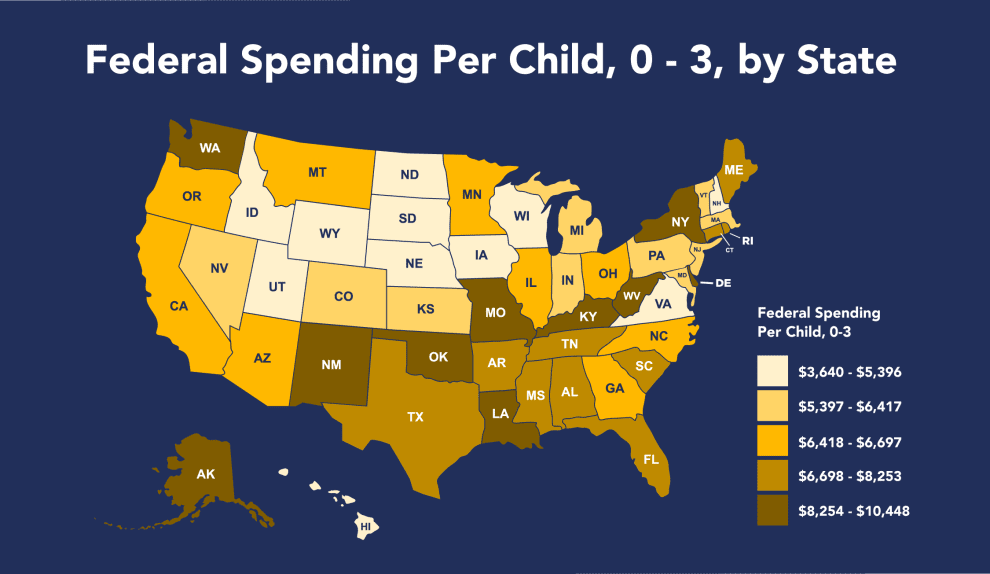
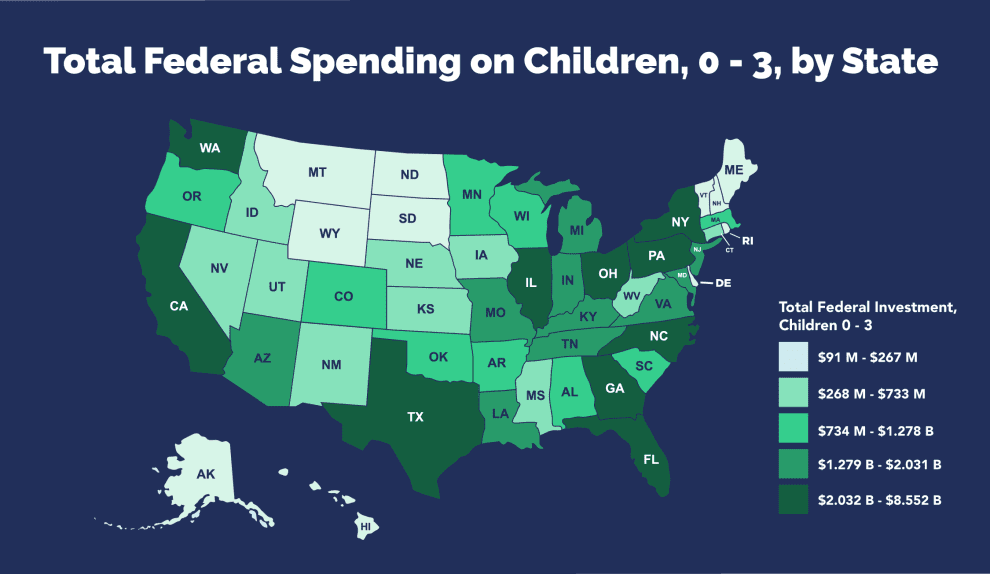
The United States invests just 8.57% of the federal budget in the nation’s children as a whole, according to Children’s Budget 2025. Children under 3 receive a far smaller share, according to Babies in the Budget 2025, despite research that shows these years to be among a person’s most critical. States with the largest populations tend to receive the greatest number of dollars for children under 3, with Texas receiving the most, followed by California, New York, Florida, and Ohio. On the other hand, Vermont, Wyoming, North Dakota, South Dakota, and New Hampshire receive the fewest total dollars from the federal government for children 0 – 3.
For state-specific details surrounding federal investment in children under 3, download the fact sheet.